

TV4 just launched its third attention study, comparing the viewing experience on its streaming service (TV4 Play) with YouTube’s big screen experience at home. It confirms once again the assumption that the streaming environment provided by a qualitative TV network (BVOD) delivers a much bigger attention than UGC platforms, such as YouTube.
An at-home test with regular users of both services
The comparison took place in December 2025, with research partner COG Research, and was built to test the attention of viewers who already used both TV4 Play and YouTube on a big screen. To take part, they had to use both services at least two to three times a week, for around 20 to 30 minutes per session. The viewing took place in participants’ homes, not in a test room. Attention was measured with an eye-tracking device (iVue glasses), as viewers chose current programmes or videos they were interested in and were told to behave as they normally would. The comparison also kept the screen conditions close: both platforms were viewed in full-screen mode and with longer video formats.
Most TV4 Play viewing happens on a big screen (76%), so the study focused on how the service is usually watched. It also tested the assumption that if YouTube viewing on TV screens moves closer to a classic ad-funded TV setup, viewers would watch it more like broadcaster AVOD, with stronger attention and greater tolerance of the commercial break. This comparison focuses on what happens when both services are used in a more TV-like way on the same household screen.
Higher attention on TV4 Play across content, ads and trailers
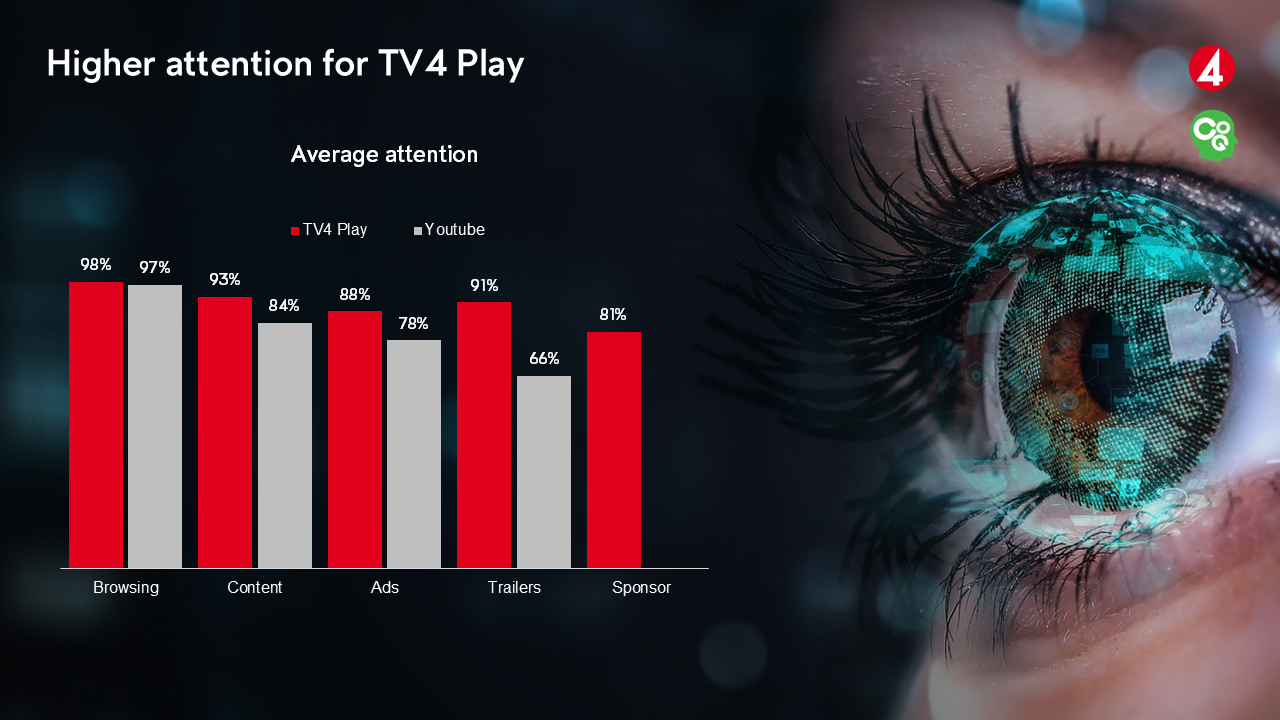
While browsing, attention was almost identical on both platforms: 98% on TV4 Play and 97% on YouTube. The difference appeared once viewing started and the commercial environment came into play.
Across the main viewing stages, TV4 Play held stronger attention:
- for content, attention reached 93% on TV4 Play, compared with 84% on YouTube
- for ads, it stood at 88% versus 78%
- for trailers, the gap widened further, with 91% on TV4 Play and 66% on YouTube
- and sponsor visibility on TV4 Play was measured at 81%.
The behavioural detail points in the same direction. While browsing TV4 Play, distraction lasted only one to two seconds; on YouTube, it stretched to five to eight seconds. TV4 Play viewing also included twice as much ad exposure as YouTube, along with close to one minute of trailer viewing. The notes also recorded only three skippable ad examples on YouTube, two of which were skipped.
Taken together, the pattern stayed consistent throughout the study: YouTube breaks were shorter and lighter, and yet attention remained lower.
A stronger sales case for the full break environment
The study gives TV4 Commercial a broader sales argument than programme attention alone. On TV4 Play, stronger attention held across the commercial sequence in the programme: the ad break, the trailer layer and sponsor visibility.
That matters in a market where more video viewing now lands on the television screen, but not all video environments behave in the same way. In this comparison, TV4 Play and YouTube shared the same screen, the same home setting and a more similar long-form viewing mode, yet the viewer behaviour still differed clearly between the two, emphasising once more that whilst the size of the screen matters, what it the biggest driver of attention is probably the qualitative environment in which the content is consumed.
Set against the same big-screen conditions, the comparison points to a difference in viewing habits, and not screen type alone. TV4 Play viewing stayed closer to the classic TV pattern: more stable through content and more tolerant of the commercial break. On the same household screen, YouTube did not produce the same viewing behaviour.
What becomes clear in all our studies is that it’s not just about screen size or format, but about behavior. Our neuroscientific studies show that the broadcast environment it still unique. Viewers make a grater mental investment, maintain focus even during advertising and give brands significantly better opportunities to create impact than on social video platforms. TV4 viewers and users are in a relaxed and engaged state of mind, and their attention is high. These are favorable conditions for ad effectiveness that make TV4 a strong medium for creating engagement with programming, but above all with ads!