

Context and objective
In late 2024, ThinkTV New Zealand, under the leadership of Jacqueline Freeman, GM Communications, undertook a full market review to understand how television was being perceived, valued, and used across the New Zealand marketing ecosystem. This was a broad diagnostic rather than a simple pulse check. It drew on perspectives from CMOs, CFOs, insights people, media agencies, creatives, and people working at the front line within television itself. The objective was not to validate assumptions already sitting in the market. It was to uncover what had changed, where belief had shifted, and why.
What the review revealed was not simply a change in channel preference or audience behaviour. It was a deeper structural problem. Television, and particularly linear television, had been repositioned in the mind of the market. It was increasingly seen as dated, less effective, and no longer central to brand building. That view was not universal, but it had become influential enough to shape recommendations, investment patterns, and confidence in where growth would come from.
The objective that followed from this work was clear. The campaign was not designed to defend television in the traditional sense. It was not designed to sell television through assertion or broadcaster rhetoric. It was designed to start a conversation across the market and reintroduce evidence into a category where understanding had eroded and assumption had started to do too much of the work.
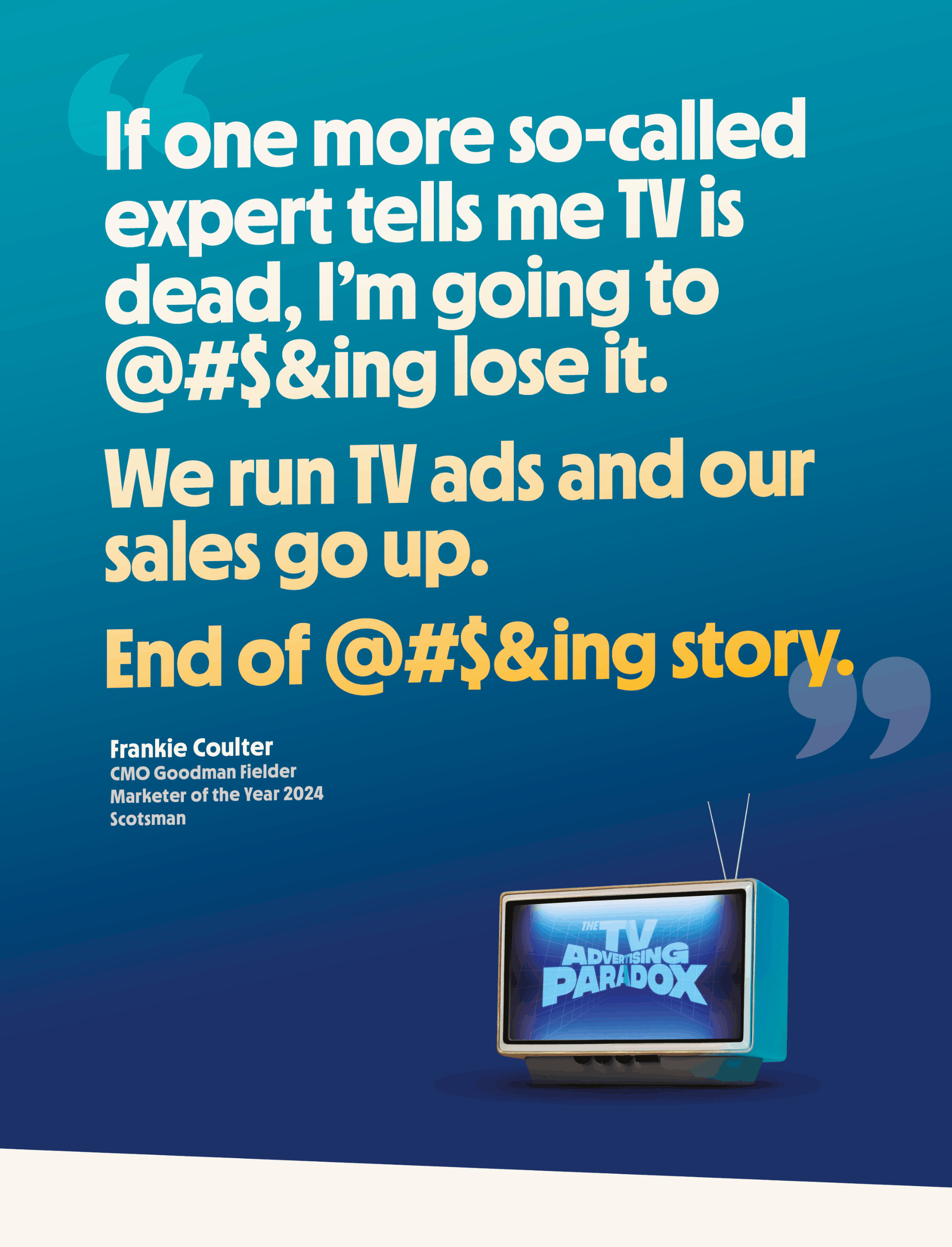
This was never about proving television works. It was about asking why people had stopped believing it does.
The market review
The full market review revealed a pattern that was both commercial and cultural. The industry had moved decisively into a performance era. Marketing decisions were increasingly being shaped by immediacy, short term attribution, and the availability of data that could be surfaced quickly and tied to visible activity. Platforms such as YouTube were producing large volumes of real time reporting, and that reporting was increasingly being read as proof of effectiveness. This narrative carried particular weight with CFOs and other commercial stakeholders, where visibility aligned more comfortably with financial reporting cycles and pressure to demonstrate short term returns.
Television does not work in that way. Its value does not always show up in the same reporting window. Its role is not to mimic the mechanics of performance media. It works at scale and over time. It builds memory structures, emotional salience, and broad reach. It supports long term brand growth rather than simply capturing immediate signals. But as the market shifted, that difference began to work against it. Measurability started to be confused with effectiveness. Channels that delivered fast data were increasingly seen as working harder. Channels that delivered long term impact were increasingly treated as less accountable, less modern, and less valuable.
That shift in belief was compounded by a decline in understanding. A new generation of marketers, strategists, and agency professionals had entered the industry with less exposure to the fundamentals of broadcast media. The language of reach, attention, effective scale, and long term brand contribution was no longer as well understood as it once had been. At the same time, audience patterns had changed from their historical peak. That change was real, but it was being misread. Instead of being understood as audience evolution within a changing media environment, it was increasingly being interpreted as evidence that linear television itself was fading in relevance and effectiveness.
Linear television was being written off at the exact moment it still mattered most.
What the review revealed
The most important finding of the review was not behavioural. It was cognitive. The issue was not that television had stopped working. The issue was that the market had stopped understanding how it works, why it works, and what it is designed to do. In that gap, other narratives had taken hold. These narratives were often built on short term metrics, partial measurement, and incomplete interpretations of effectiveness. They were persuasive because they were visible, but they were not the full picture.

This is where external evidence became critical. Karen Nelson Field’s work on attention exposed the weakness in some of the assumptions underpinning performance led thinking. In a market that had grown comfortable with the idea that 2.5 seconds of attention was enough, her research demonstrated that meaningful attention is more complex than that, and that not all attention is equal. Peter Field’s work reinforced another part of the problem. His long standing research on brand building and effectiveness, including the well known ‘Five charts to end the TV debate’, provided a rigorous counterweight to the market drift toward immediacy and narrow attribution. Together, this evidence helped articulate a simple truth. The market had changed its lens, not its reality.
The review also exposed a hierarchy of belief inside the television category itself. BVOD was still being seen positively. It was regarded as current, digital, and aligned with where the market believed media ought to be heading. Linear television, by contrast, was the part of the ecosystem being looked down upon. It was increasingly treated as something that would soon be replaced by other, supposedly more relevant media. That distinction mattered. It meant the challenge was not to convince the market that all television had value. It was to restore linear television to its proper role while showing how BVOD complements it rather than replaces it.

Prepared by Jacqueline Freeman
GM Communications, ThinkTV New Zealand
Founder of 58 and Unapologetic and Lone Wolf Media, Jacqueline Freeman advocates for a better recognition of experience, visibility and economic value in an ageing workforce. Her perspective is grounded in more than three decades in media investment, revenue leadership, pricing and negotiation.