

Beyond simplifying the buying process, audioMat has a broader ambition: to create new demand for audio advertising by making it accessible to businesses that may never have considered audio as part of their marketing mix.
The challenge: Making audio more accessible
For businesses that have never advertised on radio, getting started can feel complicated. Understanding the budget required, choosing the right stations and audience, and producing an audio advert can all seem like barriers before a campaign even begins.
Bauer Media Slovakia set out to simplify this first step, giving advertisers a practical way to explore what audio could offer before committing to a campaign.

The solution: From campaign planning to creative inspiration
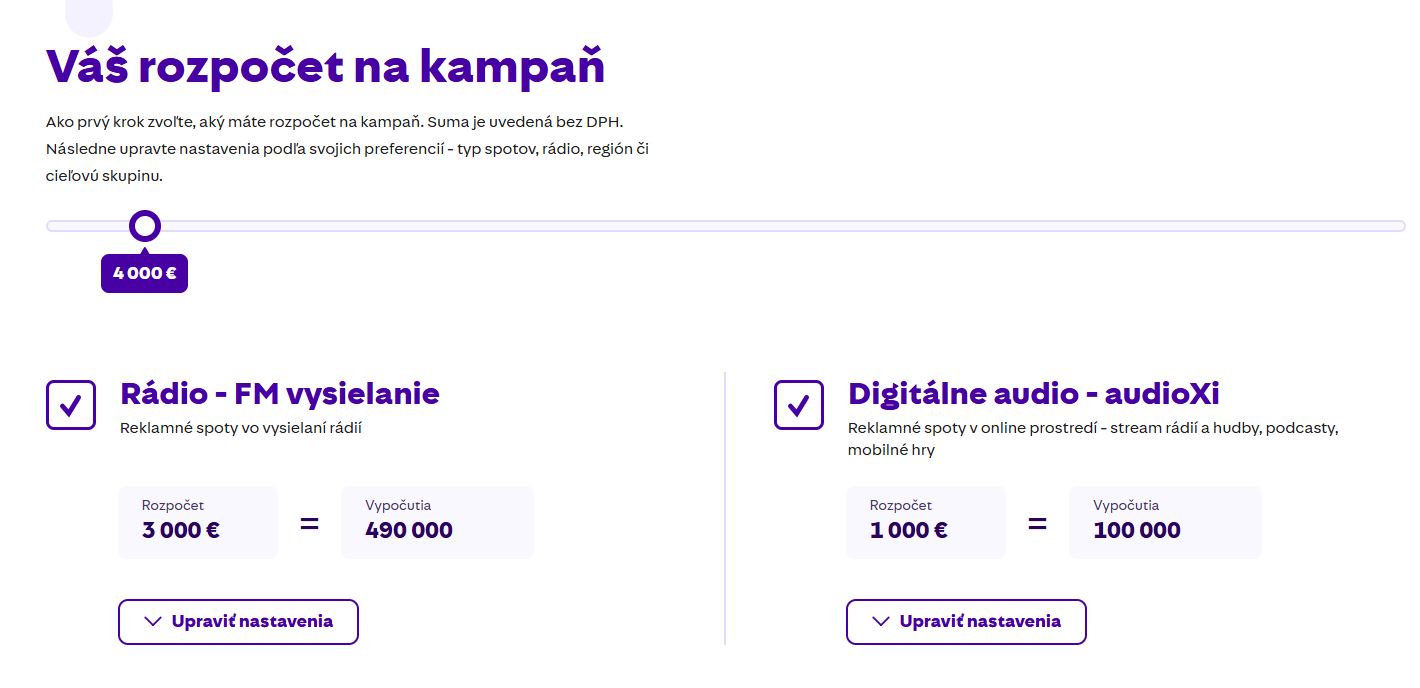
audioMat combines a campaign calculator with an AI-powered audio advert preview tool, allowing advertisers to explore both the media plan and the creative possibilities in one place.
Users begin by entering their budget and selecting their preferred advertising options. They can configure campaigns across Bauer’s FM radio stations, Rádio Expres, Europa 2, Melody and Rádio ROCK, as well as digital audio inventory available through audioXi.
audioMat also helps advertisers take the next step creatively. By describing a product or service and optionally providing a website, users can generate three AI-created audio advert previews, complete with scripts, voices and music. These examples help businesses imagine how their brand might sound in an audio environment, even if they have never produced a radio advert before.
The generated spots are for inspiration only and cannot be used directly in campaigns. Advertisers who want to proceed can request a tailored proposal from Bauer Media Slovakia’s sales team, which follows up with a non-binding offer.
Why this matters for audio
audioMat addresses two practical barriers to audio advertising: uncertainty about what a budget can deliver and uncertainty about how a brand could translate into sound.
By making campaign planning more tangible and creative possibilities easier to explore, Bauer is working to lower the barrier to entry for businesses that may not have considered radio or digital audio advertising before.
The approach also connects traditional FM radio with digital audio in a single planning experience, helping advertisers explore different ways to reach listeners according to their objectives and budgets.
Importantly, audioMat is not simply about making existing advertising transactions easier. Its broader purpose is to attract new advertisers, particularly SMEs and businesses with no previous experience of audio, creating incremental demand and contributing to the long-term growth of the audio advertising market.
What comes next
audioMat provides Bauer Media Slovakia with a digital starting point for advertisers who want to explore audio on their own terms, while retaining the expertise of its commercial team to develop and finalise campaigns.
Our ambition goes beyond simplifying the buying process. We want to make audio accessible to businesses that have never considered it before, helping them discover its potential and creating new demand for the medium.
We will continue to develop audioMat, adding further features that make the journey towards launching an audio campaign even simpler.

egta has interviewed Lenka Čamborová about the post launch results and next steps for audioMat.
egta: How many users or campaign proposals has audioMat generated since launch?
Lenka Čamborová: The initial response has been very encouraging. Within just a few days of launch, users have already generated hundreds of AI-powered audio spot previews, and we have started receiving qualified enquiries through the platform.
While it is still early to evaluate overall performance, we consider this a very promising start, particularly given our ambition to attract businesses that have never advertised in audio before.
LČ: We are already seeing the first enquiries convert into actual campaign bookings, which is a very positive early signal.
As the platform has only recently launched, we are still working with the initial pipeline of qualified leads. We would prefer to evaluate and share conversion rates once we have a more representative dataset.
egta: Has audioMat brought in new advertisers, particularly SMEs or businesses new to audio?
LČ: Yes, and this is probably the most important early success for us. We have already attracted completely new advertisers, including businesses with no previous experience of audio advertising.
This confirms that audioMat has the potential not only to simplify the buying process, but also to create incremental demand and expand the audio advertising market.
egta: Has audioMat freed up sales teams to focus on consultation and larger opportunities?
LČ: The main benefit so far is not necessarily a reduction in workload, but a significant improvement in the quality of enquiries.
Our sales team receives a detailed brief, including the advertiser’s budget, targeting preferences, campaign requirements and even an AI-generated audio spot preview illustrating what the business wants to communicate.
This enables us to prepare more relevant and personalised proposals and focus our time on advertisers who have already demonstrated genuine interest in audio.
Over time, we expect this approach to improve sales efficiency and strengthen the consultative role of our commercial team.
egta: Has audioMat helped advertisers combine FM and digital audio more often?
LČ: Our long-term ambition is to promote a Total Audio approach, combining the mass reach of FM radio with the targeting capabilities of digital audio.
At this early stage, our initial communication has focused primarily on digital audio, and the budgets submitted by advertisers have generally been better suited to digital campaigns.
However, audioMat already allows advertisers to explore both FM and digital audio within one platform. We see strong potential to encourage more integrated Total Audio campaigns as the platform develops and attracts a broader range of advertisers.
egta: Who developed the tool, and how long did implementation take?
LČ: audioMat was developed internally over several months through close collaboration between our commercial and digital teams, together with our AI Lead, supported by dedicated project management.
The most time-consuming aspects were integrating different systems and ensuring compliance with GDPR and other relevant legal requirements.
The project demonstrates the value of combining commercial expertise, digital capabilities and AI within a cross-functional team.
egta: Which additional features are planned, as mentioned in the launch announcement?
LČ: Our next priority is to enhance the platform through AI-powered marketing advisory and a dedicated educational hub for advertisers.
We want to help businesses better understand their potential customers, identify relevant target audiences and explore how audio advertising could support their marketing objectives.
At the same time, education is a two-way process. By understanding which aspects of audio advertising customers find confusing or difficult, we can improve how we communicate our offering and develop more relevant proposals.
These are just the first steps in our longer-term development roadmap.
egta: How is Bauer Media SK using feedback from advertisers to improve the platform?
LČ: As the platform has only recently launched, we are still in the early stages of collecting structured customer feedback.
We are preparing a customer feedback survey to better understand the user experience, identify potential barriers and learn which features advertisers find most valuable.
We also plan to analyse customer interactions and enquiries to continuously improve the platform, simplify the user journey and better understand what prevents businesses from considering audio advertising.
egta: Are there plans to automate more of the journey from campaign proposal to an actual booking?
Absolutely. We see audioMat as the first step towards a more automated and accessible audio advertising buying journey.
At this stage, our priority is to validate customer demand, understand how advertisers interact with the platform and assess whether this approach genuinely helps businesses with no previous audio advertising experience enter the market.
Based on these insights, we plan to gradually simplify and automate additional stages of the process, potentially including campaign proposals and booking.
Our long-term ambition is to make audio advertising as easy to explore and buy as possible, while retaining the value of personal consultation where it matters most.