
2026 will go down as a record year for global advertising, with WARC expecting spend to grow 11.9% to $1.34 trillion. But 2027 looks tougher, with growth slowing to 8.4%. In this climate, every euro has to prove its worth, and budgets are moving towards channels where intent and attention are real: CTV, DOOH and audio. Audio stands apart as an active-listening, trusted medium, deeply rooted in local communities.
Yet audio faces a paradox. Advertiser commitment has never been stronger: in Bauer Media Audio’s Sound Check Europe 2026 study, covering nine European markets, 96% of advertisers plan to maintain or increase their audio spend. Budgets, however, lag behind. Audio captures only around 5% of advertising investment while accounting for nearly a fifth of media time, and WARC forecasts the global audio market will grow just 2.5% in 2026 and 1.2% in 2027, driven almost entirely by online listening. For audio publishers, the implication is clear: growth in 2027 will not come from existing key accounts, but from new advertisers.
Radio is built on local champions: National stations, regional stations and, increasingly, in-store and in-mall audio at the point of purchase. That local reach speaks directly to proximity-driven advertisers, first and foremost SMBs such as restaurants, garages, estate agents, neighbourhood shops and franchisees. Their catchment area is a few kilometres; their KPI is footfall.
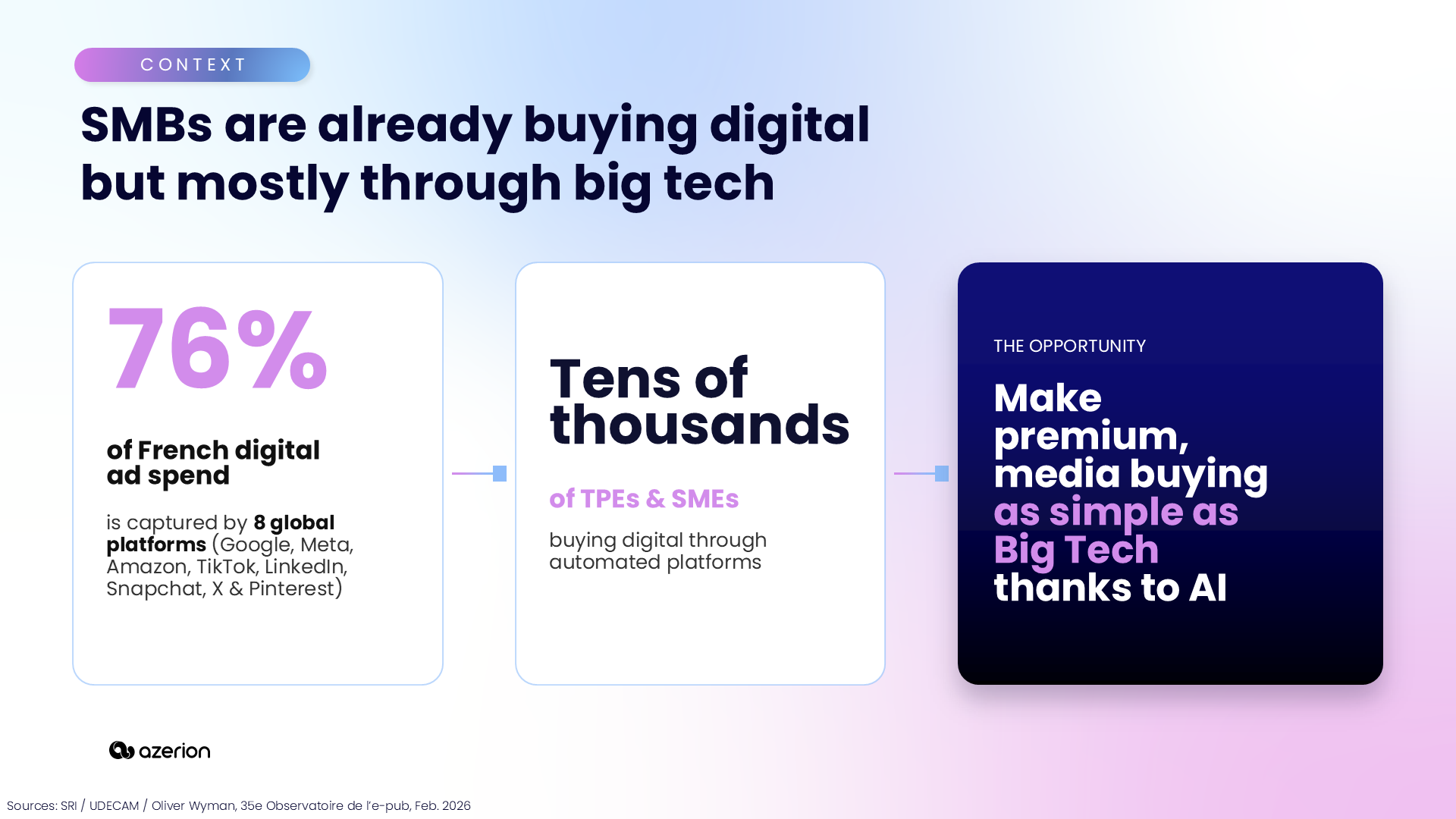
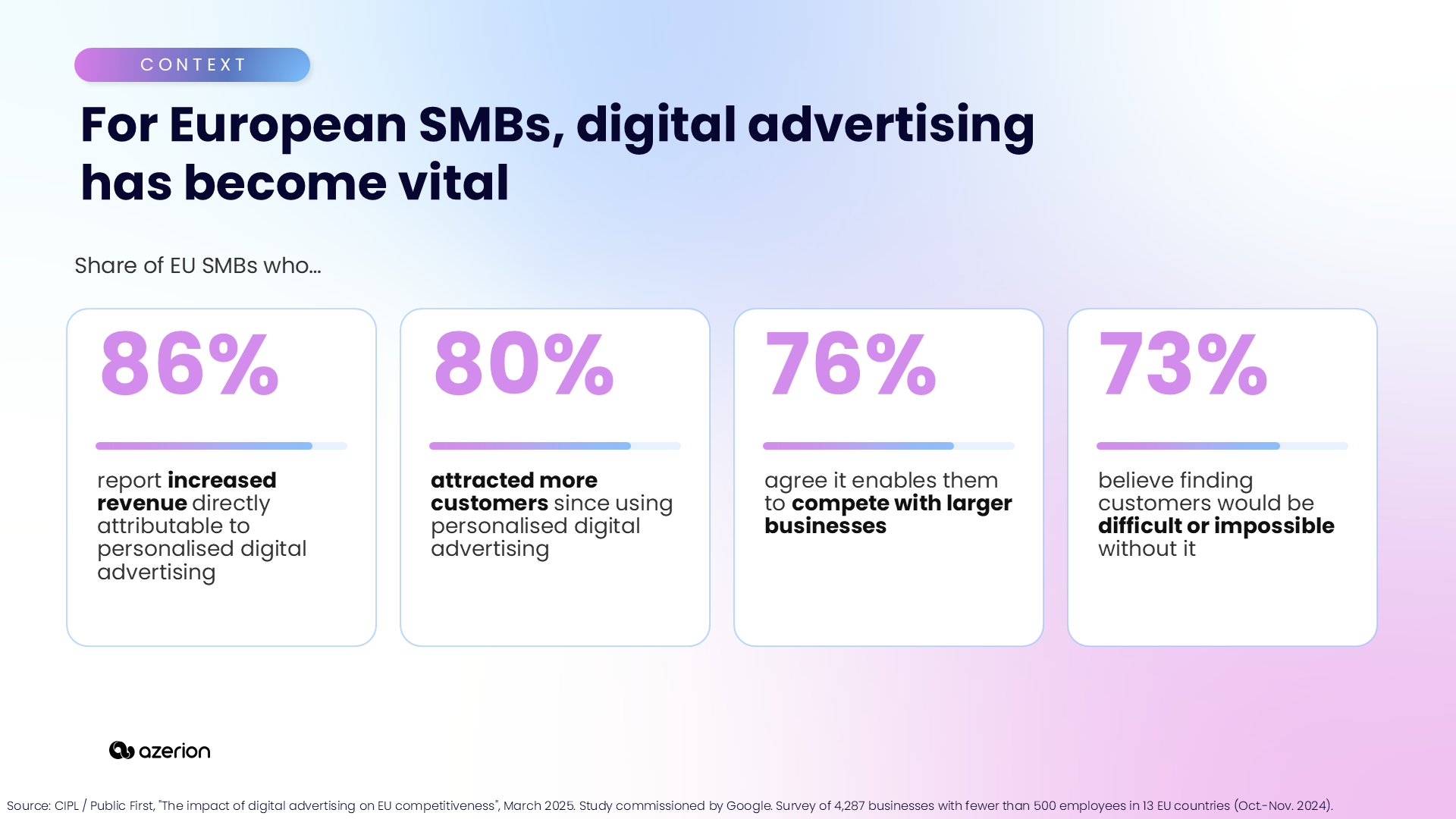
This long tail spends heavily on Meta and Google, and barely at all on radio. The reason is not campaign complexity but three concrete barriers to entry:
- Access: buying radio means finding the right agency, station or sales house. On social and search platforms, an advertiser simply opens an account.
- Ticket size: nobody calls an agency to spend €100 or €200, and small budgets rarely fit radio’s minimums.
- Creative: a radio campaign needs a spot, which means a studio, a voice and production costs that often exceed the media budget.
The sell side faces similar challenges: the manual work required to build and execute media plans often makes smaller campaigns economically unviable.
Azerion, a European full-stack advertising technology group, addresses this challenge with an AI-driven self-service platform for audio publishers, designed to remove these barriers on both sides of the market. The advertiser commits a prepaid micro-budget in a few clicks, the campaign runs automatically against their targeting, and the creative is generated by AI. For the publisher, the entire chain is automated, with no intervention from its teams: a €200 budget, unmanageable yesterday, becomes profitable.
Azerion presented this approach at the egta event in Amsterdam.
What Azerion Enables for Audio Publishers
- A chain of AI agents: starting from a simple address or business need, an audience builder agent recommends the audience, a media planning agent builds the media plan across stations, formats and in-store placements, and a delivery agent adjusts budget and targeting every day based on performance.
- AI-generated creative: a creative agent produces the spot end to end, from script to voice and sound design, with no studio and no production cost.
- One interface, readable reporting: everything runs through a single interface or a conversation with an assistant, including by voice, and reporting is readable by non-specialists, down to the store visits generated.
- International-platform targeting: beyond geography, advertisers access the toolkit of the major international platforms (demographics, interests, behaviours, location), powered by Azerion’s graph ID and made available to radio partners.
- Digital and broadcast as one audience: the same targeting logic extends to traditional broadcast, so publishers can orchestrate their digital inventory and their on-air output from one platform, whatever the listening mode.
- Full white label: radios and sales houses run the platform under their own brand, either distributed by their sales teams or opened directly to advertisers as self-service.
As media buying becomes increasingly automated, channels that cannot serve small advertisers at scale leave a growing share of local budgets to social and search platforms.
Solutions such as Azerion’s aim to give audio publishers the infrastructure to compete for that demand, with standardised workflows, automated creative and measurable outcomes, while keeping the advertiser relationship under their own brand.
Drafted by Mickael Ferreira, Chief Business Officer, Azerion
Sources
- WARC: Global Ad Spend Forecast Q3 2026
- Radio Ink: WARC audio forecast 2026–2027
- Bauer Media: Sound Check Europe 2026
- PPC Land: Bauer study details