
General information
- Country: Uzbekistan
- Company: International Media Service
- Client: AKFA Medline University Hospital
- Sector: Healthcare
- Media: National TV (edited formats in different durations); YouTube (full version); social media support
- Formats: TV spot (short edits of a long-form film) + long-form brand film (digital)
- Time period: 19 weeks on a pulsing (on–off) TV plan, spread across the year
- Budget (approx.): €30,000
Campaign objectives
To challenge the belief that only state hospitals deliver life-saving care, AKFA Medline decided to produce a doctor-led manifesto film and placed it on national TV, with IM Service handling broadcast delivery, timing, and exposure for a sensitive message.
The campaign brief combined awareness with credibility: increase brand awareness, strengthen trust and loyalty, reframe perceptions of private healthcare, and place doctors at the centre of the brand. Post-campaign evaluation was framed around brand awareness growth, emotional engagement, trust/loyalty signals, and audience response such as inquiries and interest.
The communication goal was specific: move the perception of private healthcare away from a “commercial service” label and towards clinical duty, responsibility made visible, with doctors as the proof. That choice set the tone for both creative (a manifesto-style film) and distribution (TV first, then a long-form version online).

Context
AKFA Medline is one of Uzbekistan’s largest private medical centres, transitioning toward a university hospital operating under international medical standards.
The trust barrier was cultural as much as competitive. Life-saving, high-quality medicine was widely associated with state hospitals. Private healthcare, by contrast, was often seen as commercial and limited in capability. For a private institution, that perception can narrow what audiences consider “credible” when the situation is serious. This shaped the media choice, as the plan treated television as the place where a healthcare commitment could land at national scale, with the weight of a public statement rather than the feel of a tactical offer.

Creative Minds
The advertiser and the advertising agency led the creative concept and production.
The sales house joined at activation and worked with TV channels on on-air delivery: broadcast handling, timing, and exposure planning. The priority was to keep the message clear and the tone consistent in a category where context matters.
Campaign video
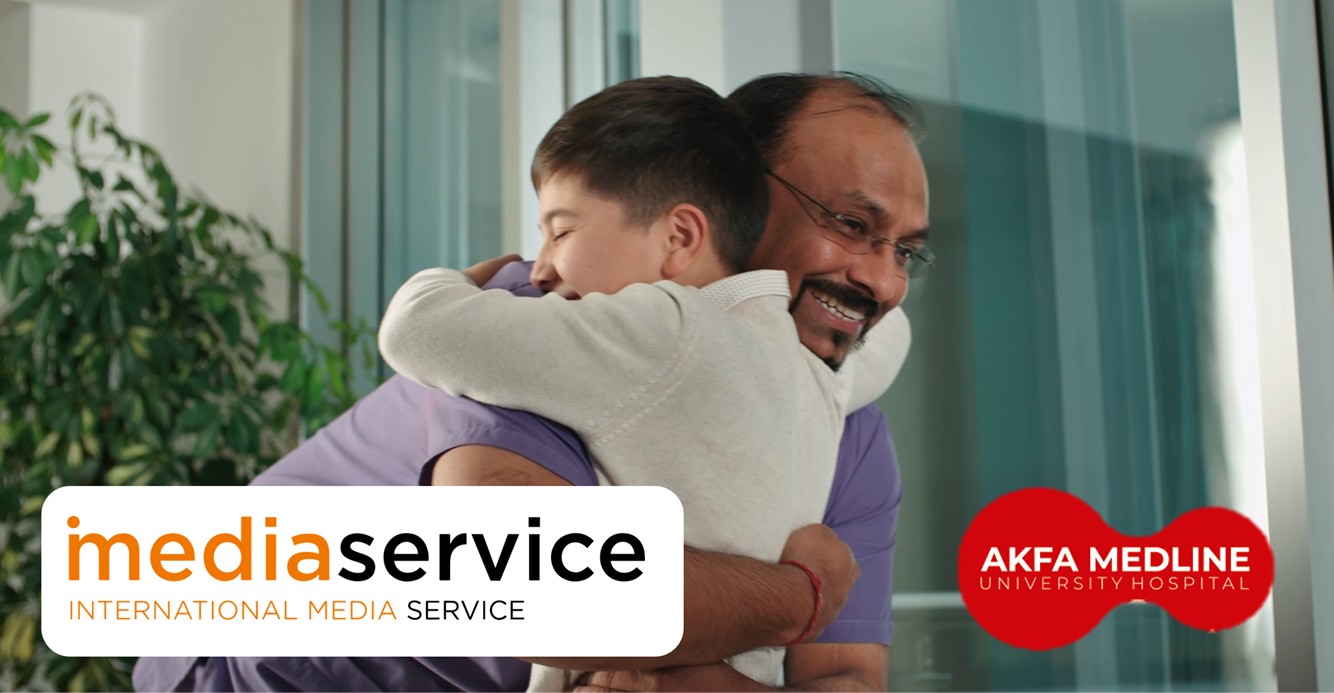
The film centred on the line: “We will not let you give up.”
Doctors were portrayed as modern-day heroes, fighting for patients’ lives “until the very end,” with emphasis on teamwork and day-to-day responsibility.
Results
TV delivery was reported through reach: 79% total campaign reach (All 30+, 3+ OTS) and 21% average monthly reach (All 30+, 3+ OTS).
Those figures were delivered through a pulsing plan across 19 weeks. With a budget of about €35,000, the schedule kept the campaign returning in bursts over the year rather than relying on one heavy run. The point of that approach was repetition: the same promise reappearing often enough to stay present, while overall reach accumulated across the full period.
The campaign’s effects were described in both short- and longer-horizon terms. Call-centre inquiries rose immediately after TV activity and were quantified as doubling. Brand awareness was also described as increasing nationwide. Recognition followed as AKFA Medline received a “Brand of the Year” award at the Brend Goda ceremony, in the category of Medical Centers.
Three practical learnings were linked to the work: television’s role as a trust-building medium for healthcare; emotional storytelling used instead of direct service advertising; and a clear split between creative development and media delivery during on-air execution. The concept was described as repeatable and influential on later campaigns, with potential relevance for other trust-based categories facing similar credibility barriers.