
MFE Advertising: Using AI to turn TV content into an advertising signal
From Spain to Italy, MFE Advertising is using AI and HbbTV to make programme context an addressable advertising signal, creating new opportunities for relevance on connected TV while keeping the control and brand safety of premium television.
What if the content on screen could determine when an ad appears?
That is the idea behind “Contextual”, an AI-powered advertising format developed by MFE Advertising, the sales house of MediaForEurope. Already deployed by their local sales houses, Publiespaña in Spain and Publitalia ’80 in Italy, the solution uses AI to identify relevant moments in TV programmes and automatically trigger an L-shaped advertising overlay alongside the content.
The result is a new form of contextual advertising for connected TV: instead of targeting who is watching, the sales house can also target what is happening on screen so that the viewer memorises the ads better, thanks to a cognitive match.
During the first nine months of 2026, more than 30 campaigns for over 20 advertisers have run across the two markets, providing MFE with valuable experience in translating contextual signals into a commercially viable advertising proposition.
Turning programme content into an advertising signal
The concept is relatively simple for the viewer, but more sophisticated behind the scenes.
During campaign planning, the advertiser and sales team agree on a set of contextual signals that reflect the campaign’s creative message and objectives. These can include people, objects, visual elements related to specific categories, or actions taking place within the programme
AI then analyses the TV feed in real time. When a predefined signal is detected, the system applies a set of campaign rules and quality controls. If the moment qualifies, an L-shaped overlay is automatically triggered next to the programme.
The programme itself continues uninterrupted, while the system automatically selects the most relevant moments for ad delivery. Depending on the campaign objectives, the advertising experience may also incorporate interactive elements, such as a QR code, enabling viewers to engage directly with the brand
This automatic selection of the advertising moment is the core innovation.
Rather than buying a conventional position in a programme and hoping the surrounding content is relevant, the advertiser defines the type of context it wants to associate with its brand. The technology then identifies suitable opportunities as the programme unfolds.
From CTV targeting to contextual CTV
For TV sales houses, the proposition sits at an interesting intersection between TV content, CTV technology, AI and contextual advertising.
Traditional TV advertising already benefits from the editorial environment in which a commercial is shown. Contextual CTV takes this one step further by making the content itself a programmable advertising signal.
It also illustrates how HbbTV can be used to add digital advertising capabilities to the linear TV experience without turning the television screen into a conventional digital advertising environment.
In Spain and Italy Contextual Advertising is delivery HbbTV across linear television.
Brand safety remains built into the process, with contexts involving violence, weapons or sexual content excluded.
For a TV sales house, this is an important part of the proposition: AI is being used to increase relevance without giving up the controls that advertisers expect from premium TV environments.
Human-led, AI-enabled
The Data team defines broad contextual categories and targeting segments aligned with the campaign objectives. AI then analyses content in real time and automatically identifies the most relevant advertising opportunities within those predefined parameters.
From smartphones to meals: different signals, different creative opportunities
Tree examples illustrate this opportunity perfectly:
In Italy, Publitalia ‘80, for Vodafone, contextual signals including texting, laptops, mobile phones and video gaming were used to create opportunities to associate the Samsung Galaxy S25 Ultra creative with technology-related moments on screen.
For Gaviscon, Reckitt’s acid reflux medicine, the team selected signals including food, lunch and drinks, allowing the advertising message to appear around meal-related content.
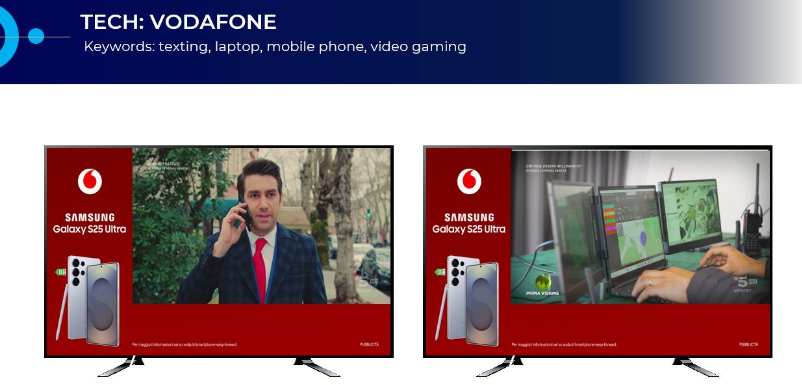
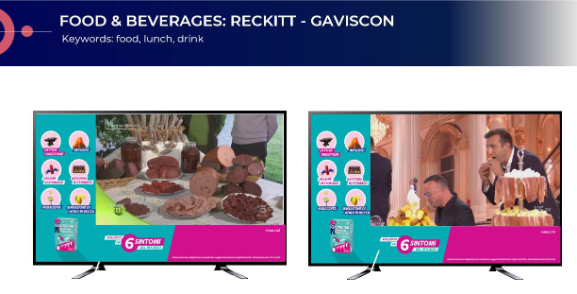


The common denominator is the ability to identify a meaningful connection between the advertising message and the content environment.
Does contextual relevance change how viewers respond?
MFE has also tested the impact of the format with Neurologyca, an independent research company specialising in human context and AI interaction.
The study involved 35 participants aged 18–55, with an equal gender split, all regular users of digital content and video-on-demand services. Three brands, Garnier Fructis, Hyundai and McDonald’s, were tested.
Neurologyca compared the Contextual format with results from its previous studies of Digital L-Shape and Interactive formats.
According to MFE, the Contextual L-Shape format generated improvements across five measures versus a standard Digital L-Shape format:
| KPI | Improvement vs. benchmark |
| Effective visualisation | +37% |
| Interest | +24% |
| Spontaneous recall | +32% |
| Desirability | +11% |
| Advertising potential | +27% |
What this means for TV sales houses
MFE’s Contextual proposition points to a broader evolution in the role of the TV sales house.
The opportunity is not simply to use AI to automate an existing advertising format. It is to turn the content itself into a richer layer of commercial intelligence.
The bigger shift is from selling an audience against a programme to selling the relationship between the audience, the content and the advertising message.
For TV sales houses looking for new ways to make CTV more valuable, that may prove to be one of the more interesting applications of AI: not replacing the role of television, but making the context around the advertising more intelligent, more relevant and more commercially actionable.
About MFE Advertising
By combining premium content, high-quality audiences and local market expertise, MFE ADV develops scalable advertising solutions that can be deployed across multiple European markets, creating greater simplicity, consistency and value for advertisers.